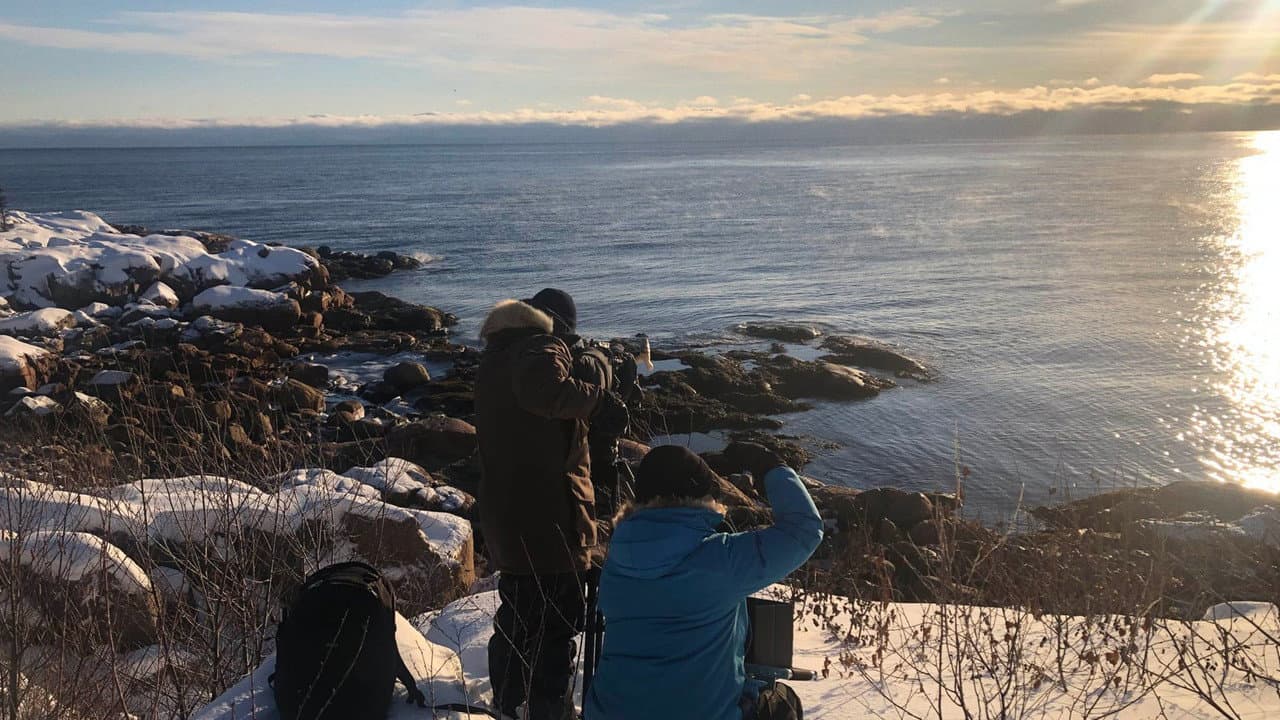
Nitassinan
Documentary
Nitassinan is a feature-length documentary that bears witness to the Innu people and affirms our history—past, present, and future. The film testifies to our vitality, our resilience, and the unbreakable bond that unites us to the land. Because Nitassinan is not only the place we come from; it is a living part of ourselves. It has nourished our language, inspired our thoughts, and guided our steps. This film is a message of love for our territory, which saw our birth and which still accompanies us today, even in our dreams.
More Like This

North Of Ourselves
2024
By attempting to travel 2,960 km from southern Quebec to its northernmost point, by bike and skis, in the middle of winter, adventurers Samuel Lalande-Markon and Simon-Pierre Goneau want to reinvest the territory and reflect on the identity and collective relationship that Quebecers have with it. Their journey begins at kilometer marker 720, an obelisk-shaped monument located on the border with the United States, and ends at Cape Anaulirvik, north of Ivujivik, the northernmost point of the Ungava Peninsula. Over the course of a 91-day expedition, they set out to meet the country in all its immensity, splendor and impetuosity, a country that suddenly reveals itself to be less abstract, less distant, more real.
More info →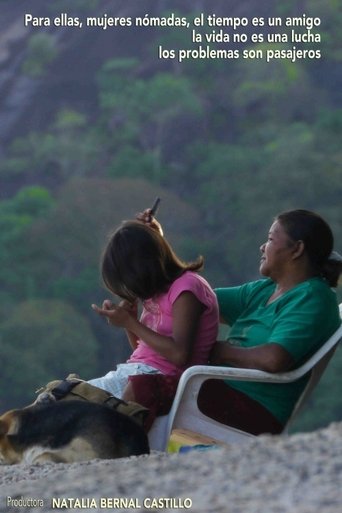
Walkers of time
2017 · ★ 7
María is an Amorúa girl; an indigenous group that traveled the savannas of Orinoquía as nomads. She lives with her grandmother Matilde, her sister diana and her cousins in Puerto Carreño, in the Colombia-Venezuela border. The amorúa are considered wild and are not literate. Matilde wants her granddaughters to learn to write and read to live better in this town of "rational whites" as they call us. The director follows María's life for 8 years from her childhood to her adolescence and invites her to travel the places her grandma did as a nomad.
More info →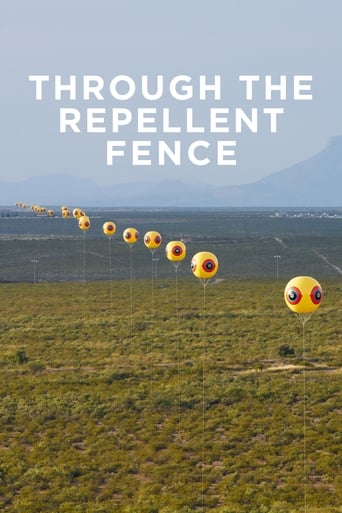
Through the Repellent Fence: A Land Art Film
2017
The film follows Postcommodity, an interdisciplinary arts collective comprised of Raven Chacon, Cristóbal Martinez and Kade L. Twist, who put land art in a tribal context. The group bring together a community to construct the Repellent Fence, a two-mile long ephemeral monument “stitching” together the US and Mexico.
More info →Living with Giants
2016
Living with Giants delves into the imaginative world of Paulusie Kasudluak, a young Inuk facing responsibilities as he transitions into adulthood. The film portrays his thoughts, his dreams, and his beliefs, and allows for an intimate immersion into his life. Paulusie is a caring son to his ailing father and a good boyfriend. But what begins as the story of an innocent teenager quickly becomes the struggle of a young man coping with the guilt of having made a huge mistake. Tragically, Paulusie takes the most dramatic decision and takes his own life. Living with Giants remains a poetic journey of resilience that echoes issues that are far greater than Paulusie's personal story.
More info →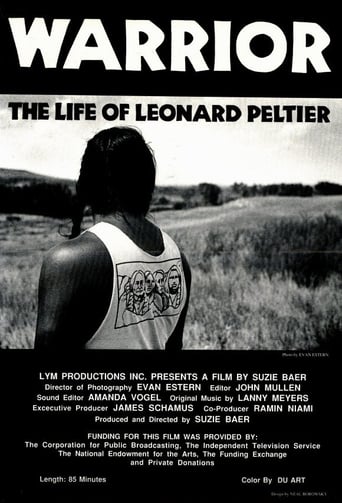
Warrior: The Life of Leonard Peltier
1991 · ★ 10
An intimate exploration of the circumstances surrounding the incarceration of Native American activist Leonard Peltier, convicted of murder in 1977, with commentary from those involved, including Peltier himself.
More info →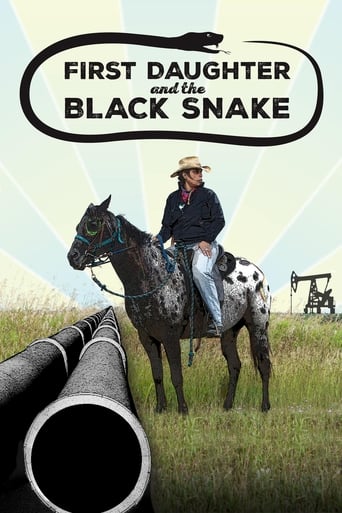
First Daughter and the Black Snake
2017 · ★ 5
The “Prophecy of the 7th Fire” says a “black snake” will bring destruction to the earth. For Winona LaDuke, the “black snake” is oil trains and pipelines. When she learns that Canadian-owned Enbridge plans to route a new pipeline through her tribe’s 1855 Treaty land, she and her community spring into action to save the sacred wild rice lakes and preserve their traditional indigenous way of life. Launching an annual spiritual horse ride along the proposed pipeline route, speaking at community meetings and regulatory hearings. Winona testifies that the pipeline route follows one of historical and present-day trauma. The tribe participates in the pipeline permitting process, asserting their treaty rights to protect their natural resources. LaDuke joins with her tribe and others to demand that the pipelines’ impact on tribal people’s resources be considered in the permitting process.
More info →Nichts als Staub in den Augen
1985
Documentary about the life of the indigenous people in the Andes and in the slums of Lima, and of their religiosity.
More info →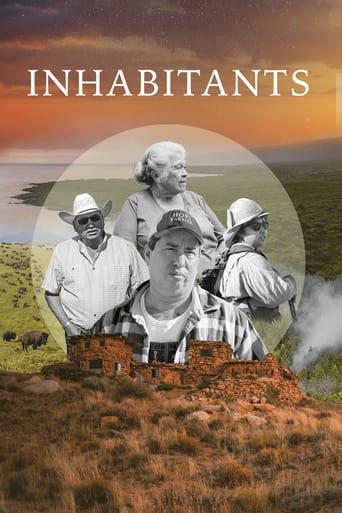
Inhabitants
2021 · ★ 9
For millennia, Native Americans successfully stewarded and shaped their landscapes, but centuries of colonization have disrupted their ability to maintain their traditional land management practices. From deserts, coastlines, forests, mountains, and prairies, Native communities across the US are restoring their ancient relationships with the land. As the climate crisis escalates these time-tested practices of North America's original inhabitants are becoming increasingly essential in a rapidly changing world.
More info →
Plains: Testimony of an Ethnocide
1971 · ★ 6.7
A documentary on the massacre of Planas in the Colombian east plains in 1970. An Indigenous community formed a cooperative to defend their rights from settlers and colonists, but the government organized a military operation to protect the latter and foreign companies.
More info →
The Annanacks
1964
This short documentary depicts the formation in 1959 of the first successful co-operative in an Inuit community in Northern Québec. The film describes how, with other Inuit of the George River community, the Annanacks formed a joint venture that included a sawmill, a fish-freezing plant and a small boat-building industry.
More info →Filhos de Macuinaíma
★ 8
Documentary about the life of three families living in the city of Boa Vista, north of Brazil. Some of them look for a more intense daily life going to parties, work and dealing with family trouble, others want to get back to the tribe. Personal crises and the search for their own identity are aspects that reveal great relevance.
More info →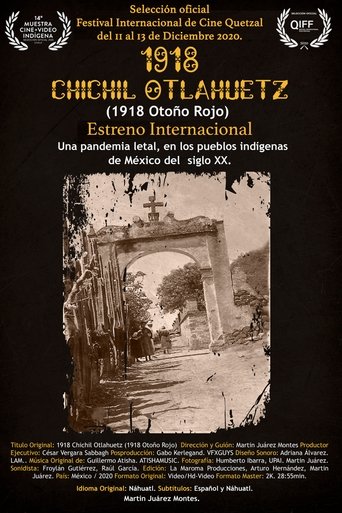
Red Autumn
2020
Historical heritage documentary about the disease that, 100 years ago, occurred during and after the Mexican Revolution. This film presents real testimonies of this cruel pandemic in the indigenous peoples of Mexico in the 20th century.
More info →