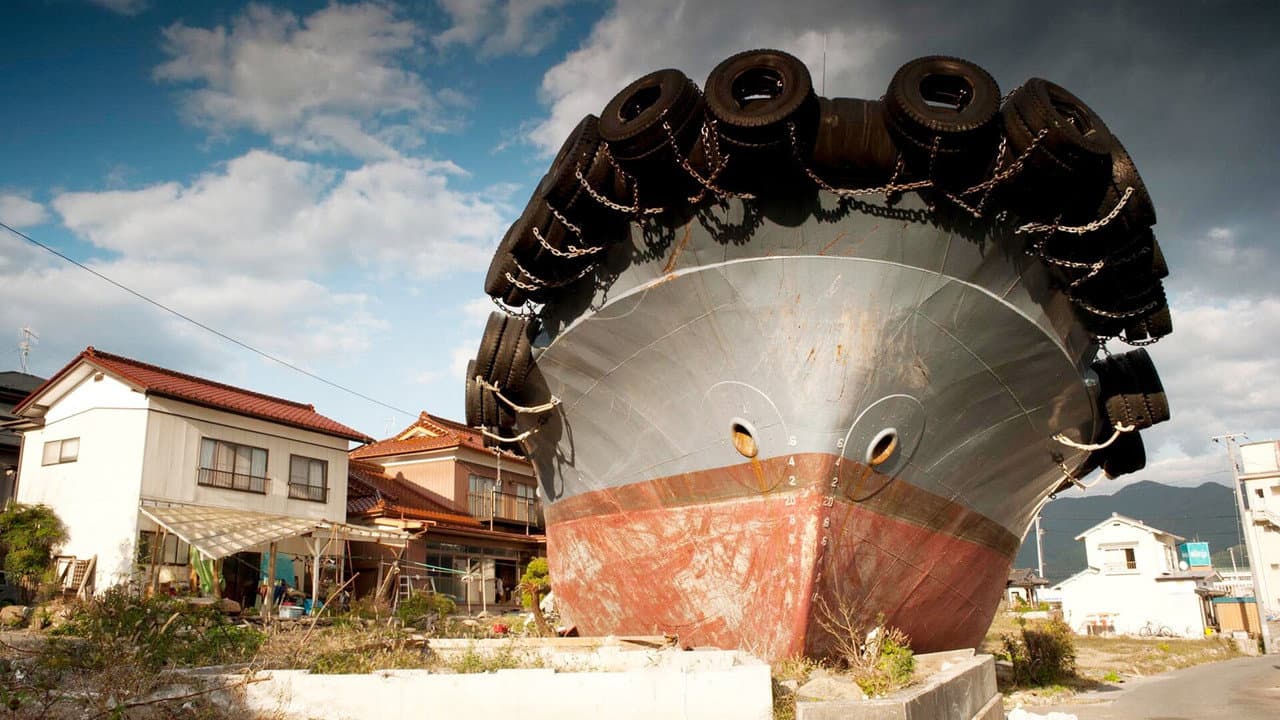
Japan's Tsunami: Caught on Camera
★ 6 · 2011 · 75m · Documentary
Eyewitness accounts of the tsunami that devastated Japan in March 2011, captured by the people who kept filming as the cataclysmic events unfolded around them.
More Like This

MEGUMI The Campaign
1989
Megumi Odaka (小高恵美) idol VHS tape, Megumi the Campaign - Idol Roke Zenkoku Jyuudan, 1989. She is best known for the role of Miki Saegusa in six Godzilla films from 1989 to 1995.
More info →
1/2 Man
1986 · ★ 7.1
A visual documentary of Einstürzende Neubauten, the German underground band, by Japanese cult director Sogo Ishii, made during their 1985 tour of Japan. The band makes an elaborate and remarkably choreographed appearance in the ruins of an old ironworks which was scheduled for demolition; footage of same was incorporated into the movie and a brief appearance on stage.
More info →
Matsuko in Real Life
2025 · ★ 7
Matsuko Deluxe explores the seemingly familiar yet overlooked facets of Japanese culture through real-life experiences.
More info →Your Chance to Live: Flood
1973
Dramatizes the plight of a young adventure seeker whose canoe is capsized by a wall of water during a flood. Shows community flood preparations, pointing out that a flood's predictability usually allows ample warning time to save lives. Designed to stimulate discussion on civil preparedness for floods
More info →Your Chance to Live: Winter Storm
1972
Intercuts scenes from Jack London's To build a fire with modern urban and rural winter scenes to point out the dangers of winter storms and low temperatures. Designed to stimulate discussion on civil preparedness for winter storms.
More info →Your Chance to Live: Pollution
1973
A surrealistic look at the future if man does not learn to control pollution.
More info →Your Chance to Live: Psychological Response
1973
The film discusses the emotional aftermath of disasters, emphasizing the importance of expressing feelings and seeking help. It highlights personal experiences of individuals affected by hurricanes and earthquakes, focusing on their feelings of guilt, anxiety, and the need for support. The discussion underscores that sharing experiences can alleviate emotional pain and that professional help should be sought for those struggling to cope with trauma.
More info →Your Chance to Live: Hurricane
1972
Released by the Defense Civil Preparedness Agency in 1972, Your Chance to Live is a series of films which cover threatening events, from forest fires, to floods, tornadoes and nuclear disasters. Hurricane tells the story of two parents who revisit the beach town where their children were killed in a violent storm the previous summer.
More info →Your Chance to Live: An Instructor's Guide
1973
The Defense Civil Preparedness Agency began an informational campaign in 1972 called Your Chance to Live. As part of the campaign, a series of films was released along with a companion book. Each installment covers a different disaster scenario, including tornadoes, blizzards, earthquakes, forest fires, blackouts and a nuclear disaster. The California Department of Education helped produce the films and hosted a workshop of educational professionals to discuss the best ways to present the desired emergency preparedness information to school age audiences. The process was filmed and assembled, along with clips from each production, and distributed as an Instructor's Guide in 1975.
More info →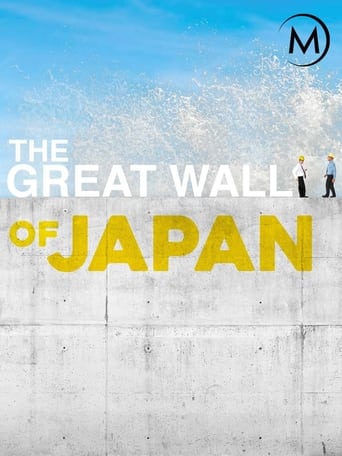
The Great Wall of Japan
2018
After the disaster of March 2011, the Japanese authorities decided to build a gigantic 15 meter high, 500 kilometer long, anti-tsunami wall, separating the land and the ocean. But what is the environmental and human impact of this wall? The population is divided on their opinion: should they cut the island off from the sea or stay vulnerable to tsunamis? Is there another way?
More info →
Top Ten Natural Disasters
2013 · ★ 4.8
National Geographic gets 10 experts to pick the most significant natural disasters ever, adding eyewitness accounts and CGI to flesh out the stories.
More info →Japan in Colour - The Wonderful World of Albert Kahn
2009 · ★ 4
In 1908, the French banker and philanthropist Albert Kahn launched one of the most ambitious projects in the history of photography. A pacifist, internationalist and utopian idealist, Kahn decided to use his private fortune to improve understanding between the nations of the world. To this end, he created what he called his Archive of the Planet. For the next two decades, he dispatched professional photographers to document the everyday lives of people in more than 50 countries all around the world. Kahn's wealth enabled him to supply his photographers with the most advanced camera technology available. They used the autochrome - the first user-friendly camera system capable of producing true-colour photographs.
More info →