EXILED Rohingya
2019 · 53m · Documentary
The silence behind the genocide of the Rohingyas in Burma.
More Like This
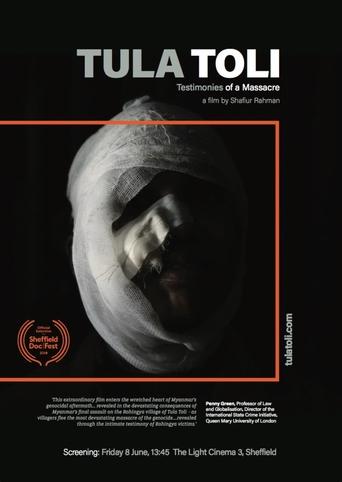
Testimonies of a Massacre: Tula Toli
Filmed along the Myanmar-Bangladesh border and within Rohingya refugee camps, Shafiur Rahman’s documentary on the 2017 Tula Toli massacre exposes chilling interviews and evidence of Myanmar military’s premeditated atrocities. The film documents mass killings, sexual violence, and the systematic destruction of the village of Tula Toli, highlighting a humanitarian crisis that forced over half a million people—many of them children—to flee in an exodus of historic scale.
More info →
From Atatürk to Erdoğan: Building a Nation
2019 · ★ 7
Turkey's history has been shaped by two major political figures: Mustafa Kemal (1881-1934), known as Atatürk, the Father of the Turks, founder of the modern state, and the current president Recep Tayyıp Erdoğan, who apparently wants Turkey to regain the political and military pre-eminence it had as an empire under the Ottoman dynasty.
More info →
The Town That Cried Bigfoot
★ 10
In the bitter winter of 1978, four desperate council members from a small Virginia town hatched a daring Bigfoot hoax to save it from the brink of bankruptcy. But as the money grew, so did the greed-triggering the town's first unsolved murder.
More info →
The Basque Ball: Skin Against Stone
2003 · ★ 6.5
An attempt to create a bridge between the different political positions that coexist, sometimes violently, in the Basque Country, in northern Spain.
More info →
Solidarność: How Solidarity Changed Europe
2019 · ★ 7
Gdańsk, Poland, September 1980. Lech Wałęsa and other Lenin shipyard workers found Solidarność (Solidarity), the first independent trade union behind the Iron Curtain. The long and hard battle to bring down communist dictatorship has begun.
More info →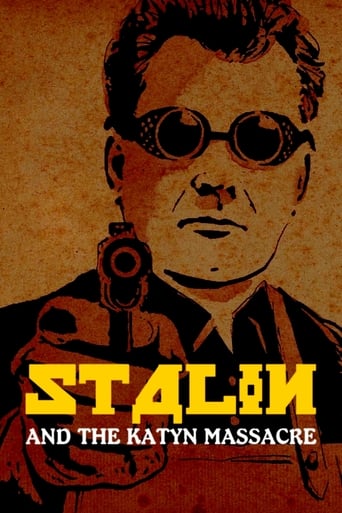
Stalin and the Katyn Massacre
2020 · ★ 7.2
The Katyn massacre, carried out by the Soviet NKVD in 1940, was only one of many unspeakable crimes committed by Stalin's ruthless executioners over three decades. The mass murder of thousands of Polish officers was part of a relentless purge, the secrets and details of which have only recently been partially revealed.
More info →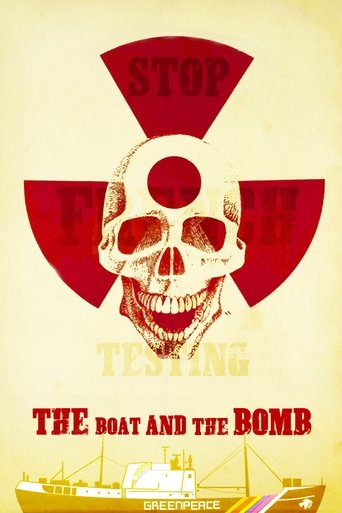
The Boat and the Bomb
2006 · ★ 7.5
In Aukland Harbour, New Zealand, on July 10th 1985, French navy combat frogmen placed two mines against the hull of the Greenpeace flagship Rainbow Warrior, sinking the ship and killing photographer Fernando Pereira.
More info →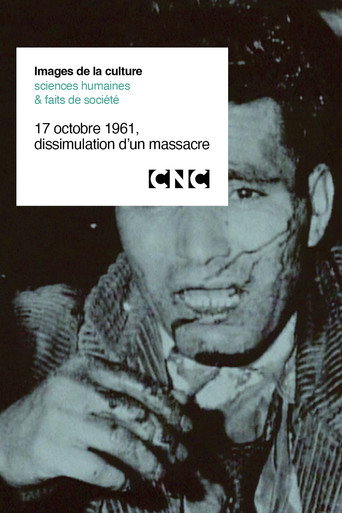
October 17, 1961, Cover-up Of a Massacre
2001 · ★ 10
On October 17 and 18, 1961, during a non-violent demonstration against the imposed curfew, dozens of Algerians were murdered in Paris by police officers acting on orders from their superiors. For forty years, this crime has been concealed; yet these events, the deadliest on French soil since the Second World War, resemble, in some respects, the darkest hours of the collaboration. Why has this history been hidden? Under what conditions, and in the name of what reasons, did officials of a democratic state conceal the scale and gravity of such events?
More info →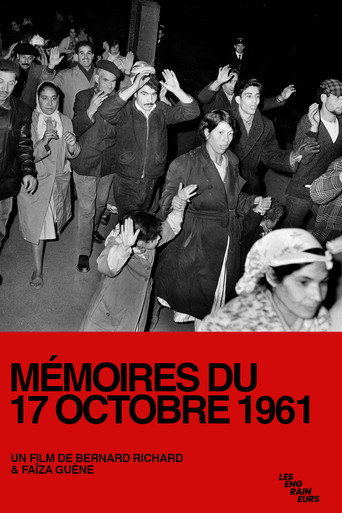
Mémoires du 17 octobre 1961
2002 · ★ 10
Three demonstrators from October 17, 1961, and a journalist recount the peaceful success of the demonstration and its brutal repression in the streets of Paris. Five months before the end of the Algerian War, the Gaullist government violently suppressed (40 to 300 deaths in a single evening, according to various sources) a peaceful demonstration by the entire Algerian civilian population of the Paris region, protesting the curfew imposed solely on this population (all participants held French citizenship). The government long denied this state crime; the official version: 3 deaths! In 1962, these events were granted amnesty by a simple decree (later enacted into law) issued by the same Gaullist government.
More info →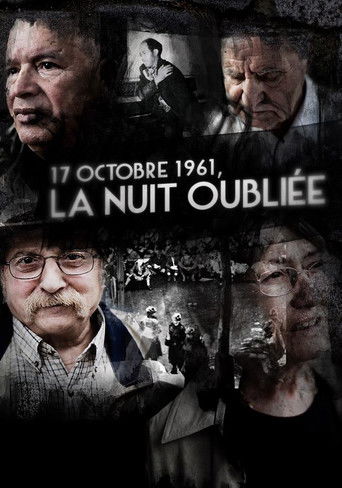
The Forgotten Night - October 17, 1961
2011 · ★ 10
On October 17, 1961, in response to the curfew imposed on Muslim Algerians by Paris police prefect Maurice Papon, the FLN Federation of France organized a peaceful demonstration in the streets of the capital. The demonstration turned into a bloody crackdown: unprecedented violence, thousands of arrests, hundreds missing, and dozens dead. Today, much is known about the violence of that night: at least 200 Algerians were killed, beheaded, beaten, or thrown into the Seine; 11,500 others were arrested and often tortured. Hundreds were deported back to Algeria. Long silenced, the repression has been acknowledged thanks to the work of remembrance and eyewitness accounts.
More info →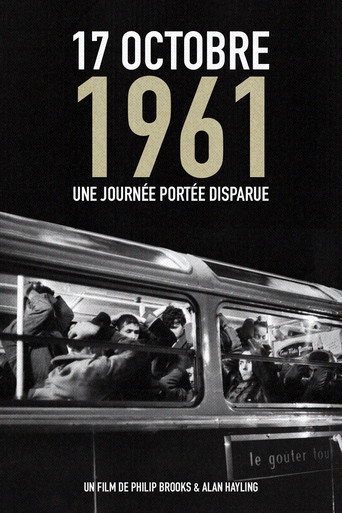
October 17, 1961: A day that went missing
1992 · ★ 10
This documentary bears witness to the events that took place more than thirty years before the filming of this movie, on October 17, 1961, in Paris, during the Algerian War. It is a work not only about historical truth but also about memory. Constructed primarily from interviews conducted with those involved in the events, along with archival footage, photographs, and radio broadcasts from the time, our investigation proves that nearly 200 Algerians were killed (drowned, tortured) that night and in the days that followed by the French police. "A Missing Day" seeks to ask two key questions: how could such events have unfolded in the capital of a Western democracy barely thirty years ago? And why have they been silenced ever since?
More info →
Shadow of Hope
2026
Far from home, a young Burmese man struggles to escape the weight of a brutal and unforgiving military coup, threatening both his nation’s freedom and its very survival. Now, in Australia and unable to return home, he’s doing everything he can to stay connected to his people.
More info →