Salvador Allende
★ 6.9 · 2004 · 100m · Documentary
A leftist revolutionary or a reformist democrat? A committed Marxist or a constitutionalist politician? An ethical and moral man or, as Richard Nixon called him, a "son of a bitch"? In SALVADOR ALLENDE, acclaimed Chilean filmmaker Patricio Guzmán (The Battle of Chile and Chile, Obstinate Memory) returns to his native country thirty years after the 1973 military coup that overthrew Chile's Popular Unity government to examine the life of its leader, Salvador Allende, both as a politician and a man.
More Like This
Nicaragua Part 1: Voyages
1985
Composed of stills by renowned Magnum photographer Susan Meiselas taken in 1978 and 1979 during the overthrow of the fifty-year dictatorship of the Somoza family. Written in the form of a letter from Meiselas to Karlin, it is a ruminative and often profound exploration of the ethics of witnessing, the responsibilities of war photography and the politics of the still image.
More info →
Nicaragua Part 3: In Their Time
1985
Through the eyes of journalists and photographers working at Barricada, the official publication of the FSLN, the film observes the problems of putting socialism into practice, with reports on the war, the economy, the prison system and the political process leading up to the 1984 elections.
More info →Nicaragua Part 4: Changes
1985
A portrait of a remote area in the rural north of Nicaragua facing difficulties with the revolutionary process. It follows Marlon Stuart, the regional FSLN political organiser, at the time of the 1984 elections.
More info →
The Freddie Mercury Story: Who Wants to Live Forever?
2016 · ★ 8
The last years of Freddie Mercury (1946-1991), rock legend and frontman of Queen, a band that conquered the world of music in the seventies and eighties: what was his lifestyle and the path that led him to a tragic death due to AIDS when he was only 46 years old.
More info →
Scenes For A Revolution
1991
The film is about aftermaths and reckonings. Revisiting material for his earlier 4-part series, Karlin returns to Nicaragua to examine the history of the Sandinista government, consider its achievements, and assess the prospects for democracy following its defeat in the general election of 1990.
More info →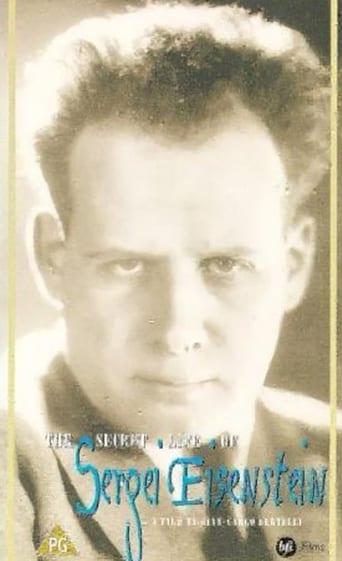
The Secret Life of Sergei Eisenstein
1987 · ★ 6.7
A biographical film, in English throughout, telling the story of film director Sergei Eisenstein (1898-1948) from his childhood in Riga, Latvia to receiving the 'Stalin Prize' in Moscow. Based on his own writings, the film uses actual film clips of Eisenstein at various points of his life as well as photographs, illustrations and archival film of a variety of locations around the world. Eisenstein's talent as a satirical cartoonist and later an artist is particularly highlighted with many photographs of his work. Films discussed include "Strike", "Battleship Potemkin", "Oktober", "The old and the new", "Alexander Nevsky" and "Ivan the terrible". There is a detailed account of Eisenstein's world tour during which time he met and worked with other leading film-makers, writers and personalities including Einstein, James Joyce, D. W. Griffith and Walt Disney. Includes anecdote on his visit to High Table at Trinity College, Cambridge and its inspiration for a scene in 'Ivan the terrible'.
More info →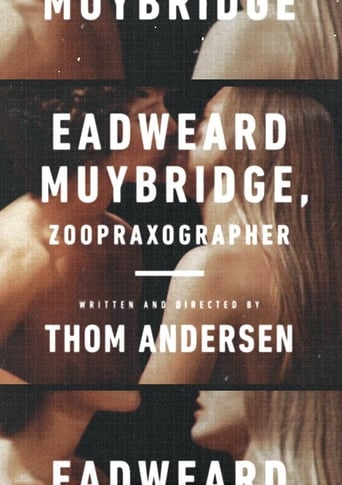
Eadweard Muybridge, Zoopraxographer
1975 · ★ 7.2
Thom Andersen's hour-long documentary adroitly combines biography, history, film theory, and philosophical reflection. Muybridge's photographic studies of animal locomotion in the 1870s were a major forerunner of movies; even more interesting are his subsequent studies of diverse people, photographed against neutral backgrounds.
More info →

From the Journals of Jean Seberg
1995 · ★ 6
Mark Rappaport's creative bio-pic about actress Jean Seberg is presented in a first-person, autobiographical format. He seamlessly interweaves cinema, politics, American society and culture, and film theory to inform, entertain, and move the viewer. Seberg's many marriages, as well as her film roles, are discussed extensively. Her involvement with the Black Panther Movement and subsequent investigation by the FBI is covered. Notably, details of French New Wave cinema, Russian Expressionist (silent) films, and the careers of Jane Fonda, Vanessa Redgrave, and Clint Eastwood are also intensively examined. Much of the film is based on conjecture, but Rappaport encourages viewers to re-examine their ideas about women in film with this thought-provoking picture.
More info →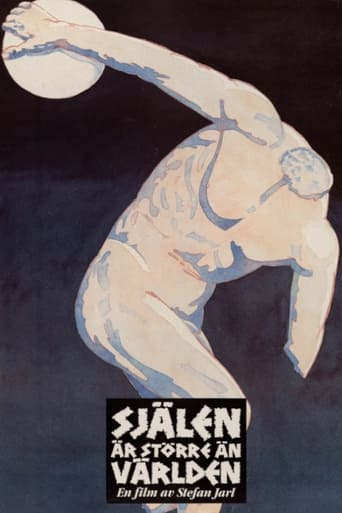
The Soul Is Greater Than the World
1985 · ★ 6.5
A documentary about Swedish Discus champion Ricky Bruch as he prepares for the 1984 Olympics. The film highlights Bruch's obsessive behavior regarding his training and preparations. Facing difficulties with the Swedish Olympic Committee, Bruch is denied the right to compete in the Olympic Games. Bent on revenge, he trains like an animal and competes in smaller competitions, ultimately throwing his career-best 71.26 meters (233 feet, 9 inches). Proving to himself and the world that he is the greatest, Ricky's throw would have won the 1984 Olympics by nearly 5 meters.
More info →