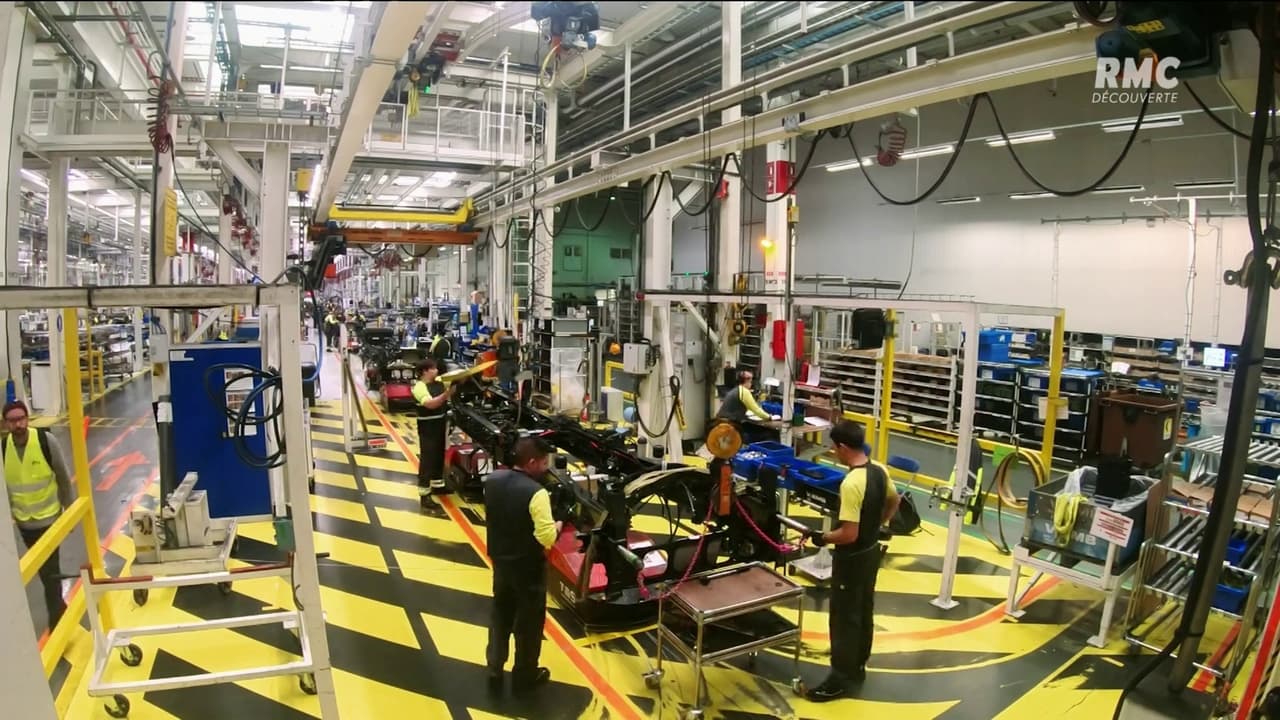
Making of: Volvo FH Trucks
★ 7.5 · 2019 · Documentary
More Like This
I Am a Truck
1953 · ★ 8
Worldy renowned for his masterpiece The Housemaid (1960), Kim Ki-young debuts with his first short film I Am a Truck (1953), which was sponsored by UN and made a year after the armistice of the Korean War. This film is a fascinating glimpse into the mind of a soon-to-be powerful auteur and influential filmmaker in the post-war Korean cinema, if not the whole history of Korean cinema.
More info →
Nous irons jusqu'au bout (les Kaolins de Plemet)
1973
Chronicle of the 9-week strike by the kaolin workers of Plémet. The film emphasizes the particular nature of such a strike in a rural commune and in a sector of the old Breton proletariat: that of subsoil mining, almost entirely liquidated after the closure of the Hennebont forges.
More info →
24 City
2008 · ★ 7
As a decades-old state-run aeronautics munitions factory in downtown Chengdu, China is being torn down for the construction of the titular luxury apartment complex, director Jia Zhangke interviews various people affiliated with it about their experiences.
More info →
Workers Leaving the Lumière Factory
1895 · ★ 6.7
Working men and women leave through the main gate of the Lumière factory in Lyon, France. Filmed on 22 March 1895, it is often referred to as the first real motion picture ever made, although Louis Le Prince's 1888 Roundhay Garden Scene pre-dated it by seven years. Three separate versions of this film exist, which differ from one another in numerous ways. The first version features a carriage drawn by one horse, while in the second version the carriage is drawn by two horses, and there is no carriage at all in the third version. The clothing style is also different between the three versions, demonstrating the different seasons in which each was filmed. This film was made in the 35 mm format with an aspect ratio of 1.33:1, and at a speed of 16 frames per second. At that rate, the 17 meters of film length provided a duration of 46 seconds, holding a total of 800 frames.
More info →
OVERHEIGHT MUST TURN
2018
For the past ten years, Jürgen Henn has filmed over-height trucks crashing into the 11foot8 train bridge affectionately nicknamed the "Can Opener." In that time, millions have viewed the crashes online. Regional, national, and international news organizations have dined out on the story and the goofy crash reels. But why do motorists continue to crash despite the many warnings, sensors, and signs? And what is it about these crashes that holds our attention? In this piece, we look for the humanity in human error.
More info →Atlas
1931
The concept of machine-made knit was known as early as the 1850s, but it was only during the 1920s that the quality of the material had improved. When the plant known as "Atlas" was introduced in 1931, the shop windows drew a lot of attention, and Aho & Soldan was ordered to make a promotional film. In this well-paced film, we see the jersey production step by step.
More info →
Charlie Marx and the Chocolate Factory
2009
Charlie Marx and the Chocolate Factory started as an investigation of the link between politics and chocolate, at the Karl Marx Confectionary Factory in Kiev, Ukraine. Since access to the factory was denied, the project had to be re-considered, re-invented or re-enacted. Mostly made of archival footage and re-enacted performances based on the company's website, the film merges what was left of the initial idea with what has been collected and realized instead. It borrows from the genres of video art, 'Man on the street' interview, direct address, corporate film, essay, and music video, without legitimately belonging to any of them. The film unravels as a reflection on its own failure, and yet keeps on investigating what has always been at stake: the shift from public to private property (and from analog to digital technology), dialectics of permanence and change, language as a mirror of ideology, and post-Soviet oligarchy culture.
More info →
Manufactured Landscapes
2006 · ★ 7.2
MANUFACTURED LANDSCAPES is the striking new documentary on the world and work of renowned artist Edward Burtynsky. Internationally acclaimed for his large-scale photographs of “manufactured landscapes”—quarries, recycling yards, factories, mines and dams—Burtynsky creates stunningly beautiful art from civilization’s materials and debris.
More info →
Megacities
1998 · ★ 6.6
Megacities is a documentary about the slums of five different metropolitan cities.
More info →

The Snack Giants – Behind the Scenes of Confectionery Manufacturers
2022
The high consumption of snacks and sweets in Germany keeps producers on their toes. In Viersen, consumer giant Mars produces 10 million cookie chocolate bars every day-and each of them must look and taste absolutely identical. In Erdmannhausen, snack pretzels are produced in the first Württemberg pretzel factory, Huober. And the Lübeck-based marzipan manufacturer Niederegger wants to use traditional production processes to produce what it claims is the best marzipan in the world.
More info →

All for the good of the World and Nosovice
2011 · ★ 6.4
An original portrayal of a small Czech village where – as the locals put it – an UFO has landed in the form of a kilometre-long silverish factory: a Korean Hyundai automobile plant. The village, hitherto famous mostly for its sauerkraut and the “Radegast” beer was thus turned into an industrial zone – the largest greenfield investment project in the Czech Republic’s history. Nonetheless, for a long time many farmers resisted selling the land upon which the factory was now standing. Eventually, they all succumbed under the pressure from the neighbours, and even the anonymous death threats. The filmmakers returned to Nošovice two years after the dramatic property buyouts, at the time when the factory has just started churning out cheap cars. Combining the perspectives of seven characters, they have composed a portrayal of a place suddenly changed beyond recognition that is playful and chilling at the same time: a politically engaged absurd flick about a field that yields cars.
More info →
Kainai
1973
On the Kainai (Blood) First Nations Reserve, near Cardston, Alberta, a hopeful new development in Indigenous enterprise. Once rulers of the western plains, the Bloods live on a 1 300-square-kilometer reserve. Many have lacked gainful employment and now pin their hopes on a pre-fab factory they have built. Will the production line and work and wages fit into their cultural pattern of life? The film shows how it is working and what the owners themselves say about their venture.
More info →