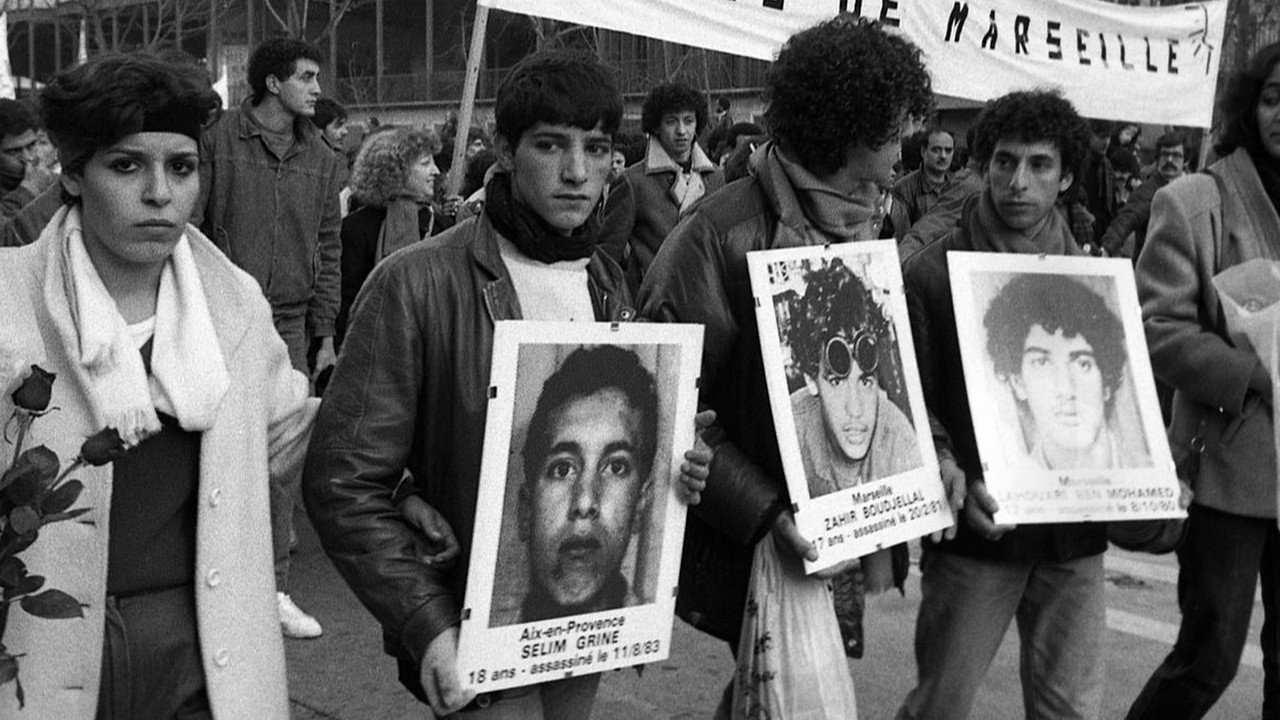
1983, The Marchers for Equality
★ 9.5 · 2023 · 54m · Documentary · TV Movie
In the 1980s, young people of North African descent born in France and a priest from the Lyon suburbs organized the "March of the Beurs." Launched on October 15, 1983, by seventeen people from the La Cayolle neighborhood in Marseille following a racist crime, the march concluded two months later—on December 3—on the streets of Paris, with 100,000 participants. This movement demanded equal rights. Was their cry heard?
More Like This
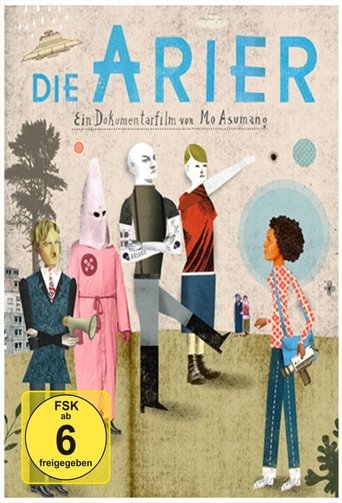
The Aryans
2014 · ★ 6.7
THE ARYANS is Mo Asumang's personal journey into the madness of racism during which she meets German neo-Nazis, the US leading racist, the notorious Tom Metzger and Ku Klux Klan members in the alarming twilight of the Midwest. In The ARYANS Mo questions the completely wrong interpretation of "Aryanism" - a phenomenon of the tall, blond and blue-eyed master race.
More info →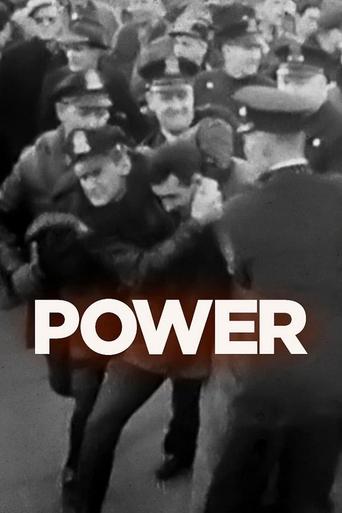
Power
2024 · ★ 7
Driven to maintain social order, policing in the United States has exploded in scope and scale over hundreds of years. Now, American policing embodies one word: power.
More info →
Leigh-Anne: Race, Pop and Power
2021 · ★ 7.2
Pop star Leigh-Anne Pinnock confronts her experience as the only black member of Little Mix, and as a black woman in the music industry. She embarks on her own very personal journey to understand how she can use her platform and privilege to combat the profound racism she sees in society around her.
More info →
Sahara Vertical
2006 · ★ 10
Following in the footsteps of Frison Roche, 7 climbers explore the main Hoggar massifs in Algeria. Their main objective is the ascent of the Garet El Djenoun summit via the north ridge, a long climb symbolic of a certain difficulty and a significant commitment, due to its location in the desert. They also attempt the Diedre Agresti, a daring route from the 70s, opened in around ten days on artificial, and unequipped; it is a path that has never been repeated; the objective is to do it free and almost only on wedges, with difficulties up to 7b/c in a sometimes very delicate rock... Excerpts from the film shot in 1970 by Henri Agresti on this same route, allow us to compare the technical and material means of the time to those of today. They also discover the beauty of the Algerian desert, its silence, its rock paintings, the customs of the Tuaregs, etc... a fascinating journey.
More info →Dresden Story
1954 · ★ 7
People are interviewed in Dresden, Ontario, to sample local attitudes towards racial discrimination against black people that brought this town into the news. After a round-up of the opinions of individual citizens, white and black, commentator Gordon Burwash joins two discussion panels, presenting opposite points of view. The rights and wrongs of the quarrel are left for the audience to decide.
More info →
Trump's America: Power, Change, Resistance
2026 · ★ 7
With his ultra-conservative policies, US President Donald Trump is disrupting the global order as well as US institutions and society. Filmed less than one year after the start of his second mandate, this documentary analyses the concrete impact of his policies on the American people.
More info →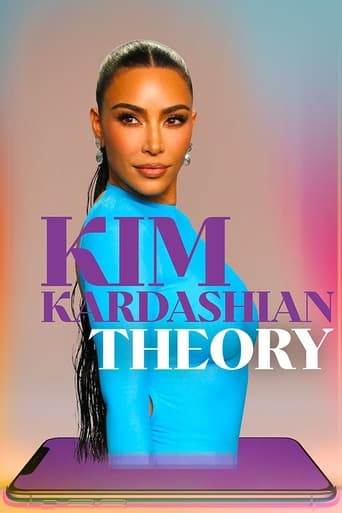
Kim Kardashian Theory
2024 · ★ 4.8
Kim Kardashian is the embodiment of our times. She's a total social figure. To analyze her is to talk about ourselves, our relationship with social networks, capitalism and aesthetic standards. Through the eyes of journalists Nesrine Slaoui and Guillaume Erner, this film proposes a theory in the zeitgeist, crossed by questions of race and gender. Journalist and sociologist Guillaume Erner wonders why Kim Kardashian is the most followed woman in the world on social networks "when she does nothing". With the help of journalist and director Nesrine Slaoui, he paints a portrait of this "total social character", who is famous because of... her fame. Fashion icon, star of a never-ending reality TV family saga, savvy businesswoman, future lawyer and activist outraged by the state of American prisons, the beautiful Kim, who is said to be tempted by a political destiny, is in fact not idle at all...
More info →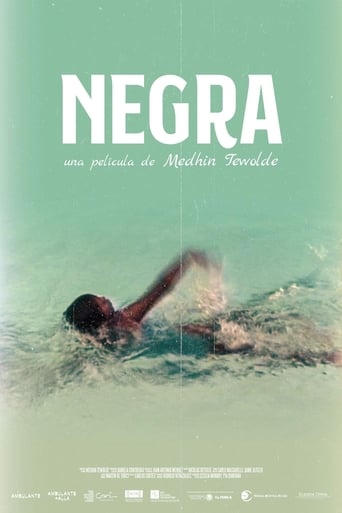
Negra
2020
I was about seven years old the first time someone called me \"black\" on the street. I turned around to see who they were talking to, until I realized they were talking to me.
More info →OJ: Trial of the Century
2014 · ★ 7.7
OJ: TRIAL OF THE CENTURY, premiered on June 12, 2014 and it chronicles the twists and turns of the OJ Simpson murder trial and allows viewers to relive every moment of the investigation first-hand.
More info →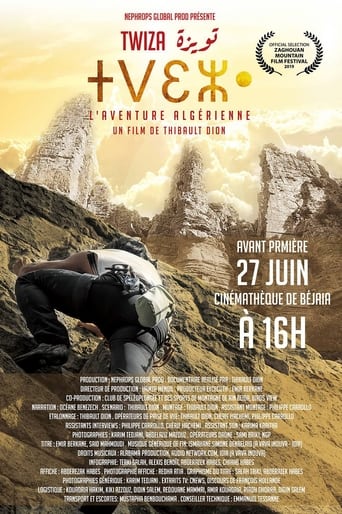
Twïza, L'Aventure Algérienne
2019 · ★ 10
In Tamazight culture, "Twïza" symbolizes a gathering for sharing and mutual support. This is precisely what Thibault Dion's film explores – January 2019 – as five French climbers land at Constantine airport. While they initially thought they would simply be opening climbing routes in eastern Algeria, this group of climbers from Grenoble discovers much more. Their initial apprehension about exploring this isolated region, coupled with the warm welcome, good humor, and rich culture, transforms their journey into an unexpected human adventure. Fabulous landscapes, thrilling experiences, unforgettable moments, smiles – beyond borders, in the land of friendship and hospitality... Algeria.
More info →Love and Sex in West Africa
2022
Ivory Coast, the Democratic Republic of Congo, and Senegal – when it comes to love and sex, these African countries are caught between tradition and modernity.
More info →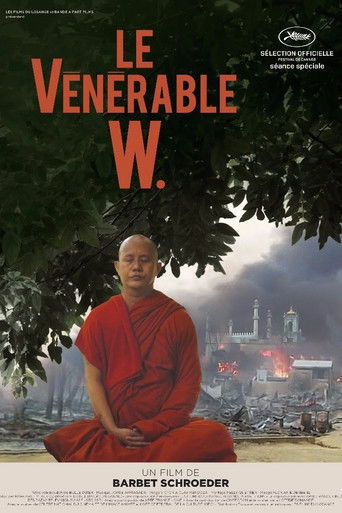
The Venerable W.
2017 · ★ 6.6
A view of the religious tensions between Muslims and Buddhist through the portrait of the Buddhist monk Ashin Wirathu, leader of anti-Muslim movement in Myanmar.
More info →