The Pacifist Who Went to War
★ 9 · 2002 · 52m · Documentary
This documentary is the story of two Mennonite brothers from Manitoba who were forced to make a decision in 1939, as Canada joined World War II. In the face of 400 years of pacifist tradition, should they now go to war? Ted became a conscientious objector while his brother went into military service. Fifty years later, the town of Winkler dedicates its first war memorial and John begins to share his war experiences with Ted.
More Like This

The Seabees on Iwo Jima
2023
Narrated by CBS Sports' Jim Nantz. The Seabees on Iwo Jima focuses on the United States Naval Construction Battalions in World War II, which built all the infrastructure for the Allies in Europe and the Pacific in WWII. The Seabees were construction workers by trade but had to fight at times. Their motto was "We Build, We Fight," and their biggest test came in the battle for Iwo Jima in 1945.
More info →
Requiem for Auschwitz - the film
2022
13 years ago, director Bob Entrop made the film A piece of blue in the sky, the first film in the Netherlands that depicted the murder of almost 1 million Sinti and Roma during the Second World War. There is a taboo on what happened during the war, you don't talk about it with anyone and certainly not in front of a camera. Requiem for Auschwitz is a sequel, with the most valuable moments from the first film, supplemented with the grandchildren and the creation and performance of the 'Requiem for Auschwitz' by Sinti composer Roger Moreno Rathgeb by the Sinti and Roma Philharmonic from Frankfurt and a Jewish choir in the Berliner Dom in Berlin, during Holocaust Memorial Day. During his visit to Auschwitz in 2020 with four musicians from the Dutch Accompaniment Orchestra, Roger shows them the places that inspired him.
More info →

As If It Were Yesterday
1980 · ★ 7
Documents the little-known heroism of the Belgian Resistance who, during the Nazi occupation, hid over 4,000 Jewish children, rescuing them from deportation and extermination, , often risking their own lives. Directed by Myriam Abramowicz and Esther Hoffenberg, children of parents who spent the war in hiding, the film inspired the creation of The Hidden Child, a world-wide network of hidden children, which, for three decades, has organized reunions of hidden children with the families who hid them in Belgium during WWII.
More info →
The Russia We Lost
1992 · ★ 7
The sequel of feature-publicistic film «You Can’t Live Like That». Showing the countrymen charmless and sometimes scaring life picture of once great power with pain and anger, the author tries to uncover the reason of the country’s and nation’s tragedy.
More info →FDR: A Presidency Revealed
2005 · ★ 7
For twelve years he stood as America's 32nd President, a man who overcame the ravages of polio to pull America through the Great Depression and WWII. From his legendary Fireside Chats to his sweeping New Deal, Franklin Delano Roosevelt revolutionized the American way of life. FDR: A Presidency Revealed examines one of history's most compelling figures. Inspired by his cousin Teddy Roosevelt, Franklin D. Roosevelt rose to the nation's highest office during the depths of one of its darkest periods. A man of few words, he brought a nation together through his revolutionary Fireside Chats. He introduced vast reforms like Social Security and work relief for the unemployed. At the same time, his administration hid a dark underbelly teeming with covert maneuvers, spy rings, and powerful enemies.
More info →
The Rise and Fall of Adolf Hitler
2008
Explores the path of hitler from insignificance, to World domination, and demonstrates the delusions he had that lead to massive deaths during the War.
More info →
The Tuskegee Airmen: Return to Ramitelli
2023
Narrated by Country Music Superstar Darius Rucker. We return to Ramitelli airfield in Italy to chronicle the legacy of World War II's famed Tuskegee Airmen, African American pilots who helped break stereotypes and helped win World War II with their incredible fighter escorts of American bombers.
More info →
The Last Season
2014 · ★ 6.6
In search of the lucrative matsutake mushroom, two former soldiers discover the means to gradually heal their wounds of war. Roger, a self-described 'fall-down drunk' and sniper in Vietnam, and Kouy, a Cambodian refugee who fought the Khmer Rouge, bonded in the bustling tent-city known as Mushroom Camp, which pops up each autumn in the Oregon woods. Their friendship became an adoptive family; according to a Cambodian custom, if you lose your family like Kouy, you must rebuilt it anew. Now, however, this new family could be lost. Roger's health is declining and trauma flashbacks rack his mind; Kouy gently aids his family before the snow falls and the hunting season ends, signaling his time to leave.
More info →
Reunion
1946 · ★ 6.8
Live footage from concentration camps after the liberation, and the complex transport and lodging of masses of prisoners of war and other deported people back to their home countries, at the end of World War II. A 45min 35mm print also exists (shown at Cinémathèque française in 2023).
More info →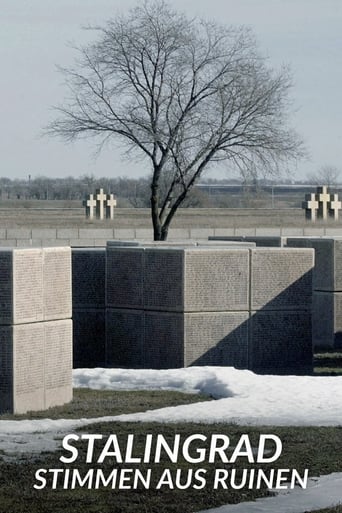
Stalingrad - Stimmen aus Ruinen
2023 · ★ 7.9
Featuring excerpts from diaries and letters written by local residents and soldiers from both sides, the documentary tells the story of the Battle of Stalingrad through the voices of those who lived it.
More info →