A Natural History of Laughter
★ 6.3 · 2011 · Documentary
For how long have we been laughing? Are human beings the only ones to laugh? In the past, scientists tended to neglect such questions of laughter, leaving them to the philosophers. Jacques Mitsch's A NATURAL HISTORY OF LAUGHTER explores recent scientific attempts to explicate this most elusive of human faculties, undertaken by scientists who see it as a means of approaching some of the larger mysteries of neurology and human behavior.
More Like This
City of Splendour
2013
A documentary about punk and subculture scene of Pula, Croatia from 1978 to 1991, the city that gave birth to one of the most vivid punk and alternative rock scenes in former Yugoslavia, despite having population of just over 60,000 residents.
More info →
E42
2015
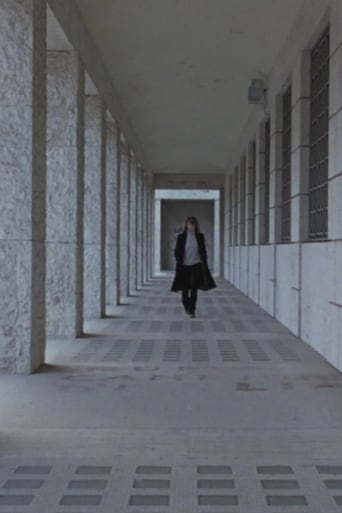
E42 is a cinematic exploration of the area in Rome knows as the EUR, a modernist landscape that was originally designated by Mussolini as the the site of the World Fair of 1942 and as a celebration of the 20 year anniversary of Fascism. Originally designed as a monumental space for public performance and collective acts of solidarity to the Fascist regime, this landscape was in fact never inaugurated. After the war, the 420 acre area was recuperated and today projects a timeless aura of an unfinished and temporary, empty and silent, monumental and imposing as well as an ephemeral landscape.
More info →
¡Votad, votad, malditos!
1977 · ★ 7
On June 14, 1977, the eve of the first democratic elections after Franco's regime, Llorenç Soler and his crew go out into the street and ask passers-by which party they are going to vote for.
More info →
Pierre Bonnard : les couleurs de l'intime
2015
How did Bonnard, one of the great masters of 20th-century painting, a secretive, anxious man with an ordinary everyday life, become this undisputed painter of intimacy, capable of transforming reality into a unique and incandescent world? Through his paintings, but also his private journals, his correspondence with Matisse and Vuillard, the photographs he loved, and the places where he lived, the film immerses us in the world of this master of color.
More info →Bosnia!
1994 · ★ 4.3
The carnage in Sarajevo provides the focus of this French documentary which seeks to call attention to the terrible conflict in the hopes of finally ending it. The film is divided into five parts. Each part covers a time frame ranging from April 4, 1992, the beginning of the war, to the present. The major issues that occur are three-fold. It depicts the systematic genocide of Bosnians, the silence of Western countries, and the determination of the Bosnians to resist. They refuse to be seen as victims, even though the filmmakers portray them so. Also included are the origins and political aspects of the war. It offers interviews with participants. It also reveals how the U.S. State Department censored reports about Serbian death camps.
More info →
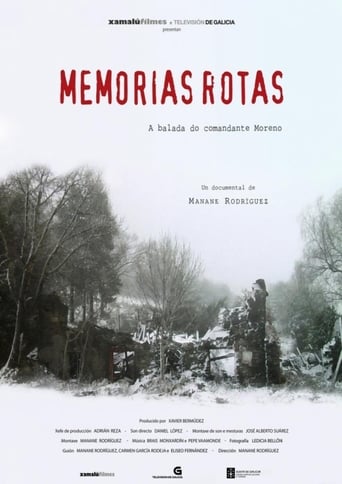
Broken Memories
2010 · ★ 6
An audiovisual chronicle of the Spanish Civil War in Galicia. Memorias Rotas centers on a group of republican fighters leaded by Commander José Moreno. The group disappears as they fail trying to escape by sea in the border between Galicia and Asturias and nobody ever knows about them.
More info →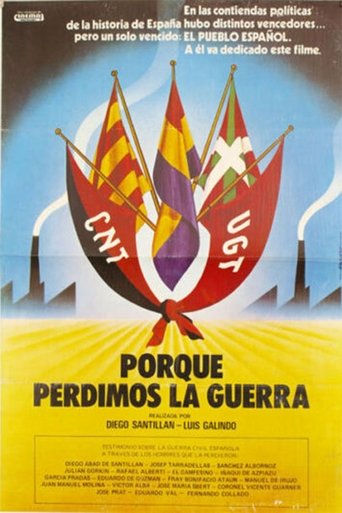
Why Did We Lose the War?
1978 · ★ 7
A documentary about how Republican forces lost to Franco in the Spanish Civil War.
More info →
Everyday Life
1976 · ★ 5.2
Dialogue-free short detailing the daily tasks of a man and his wife.
More info →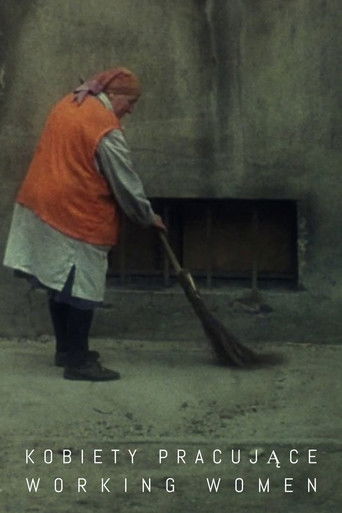
Working Women
1978 · ★ 5.1
Stylized with dramatic interiors and a distorted frame rate, this early documentary miniature from Szulkin depicts six sequences of solitary, repetitious labor.
More info →