Permutations
★ 6 · 1968 · 8m · Documentary · Animation
An experimental short film by John Whitney Sr. which combines animated shapes and colors; Computer graphics as dynamic, swirling art. Preserved by the Academy Film Archive in 2014.
More Like This

Shapes and Gestures
1977
Begins as a whimsical piece with 'sheets' of lines running down the screen, progressing into more and more complex geometic patterns but without deviating from the basic precepts of 'dot and line' animation. Jazz piano on a lazy Sunday afternoon, and a spring color palette. -- Stephanie Sapienza. Preserved by the Academy Film Archive in 2001.
More info →Dream of the Sphinx
1971
Gore's second solo film, DREAM OF THE SPHINX is highly representative of his fluid, expressive line work and characteristic traversals through space. Preserved by the Academy Film Archive in partnership with CalArts and iotaCenter in 2009.
More info →The Letter
1970
A collaborative piece by Gore and Beckett, the film begins with one of Gore's characters composing a letter, to eventual mail it. Beckett's animation takes over at this point, transforming the envelope into a looping, cascading form that seems to be perpetually turning itself inside out. A brief Gore finale bookends the piece, which is one of only two extant examples of Gore's unique animation work. This film is usually appended to Gore's own Dream of the Sphinx. [Source: Mark Toscano] Preserved by the Academy Film Archive in partnership with CalArts in 2009.
More info →Daumë
2000 · ★ 5.7
Culled from four rolls of Super-8 film shot while the maker was a development worker in a small South American village, Daumë is at its center a film about ritual, power, and play. Daumë is both ethnography and critique; it is an interrogation into how to represent a place that can't be represented.
More info →Terra Incognita
2002 · ★ 5.8
Terra Incognita is a lensless film whose cloudy pinhole images create a memory of history. Ancient and modern explorer texts of Easter Island are garbled together by a computer narrator, resulting in a forever repeating narrative of discovery, colonialism, loss and departure.
More info →The Red and the Blue Gods
2005 · ★ 4
An ethnographic field report in which the Anthropologist describes the mythic creation of an unnamed ‘sun-scraping structure’ through the ritualized actions of the Red and the Blue Gods.
More info →The Unicycle Race
1966
An animated film drawn in india ink directly on 65 mm film. It was reduced optically to 35mm film with colour added. The story of the film concerns a rivalry between two simple stick figures characters for the championship in a unicycle race. Preserved by the Academy Film Archive in 2011.
More info →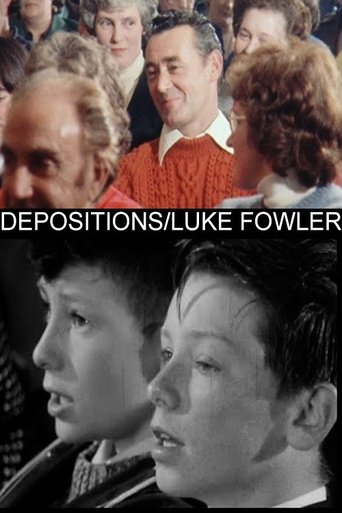
Depositions
2014
The quietly insistent and critical DEPOSITIONS attempts to restore some dignity to images of the communities of the Scottish highlands taken from patronizing BBC documentaries and news features from the 70’s and 80’s. DEPOSITIONS repurposes footage from the archives of the BBC and sound from the School of Scottish Studies, it is a film about differences and dichotomies: science and superstition, near and far, community and the individual.
More info →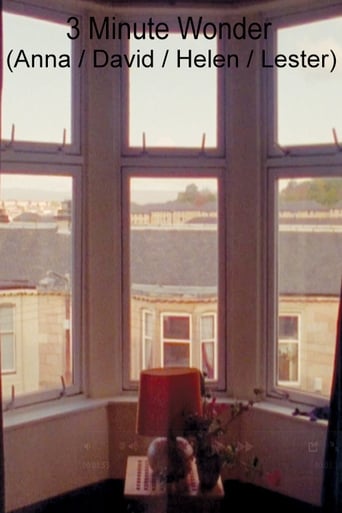
Tenement Films
2009
A series of portraits, made for Television, of four diverse individuals brought together through shared residence. These short films were filmed in the tenement where I lived for eight years. The first is shot in our bedroom, which doubled up as my former partner's office, the three others were shot in architecturally identitical spaces owned by my then neighbours. Shot and edited on a single 16mm bolex camera using available light throughout, the films invoke reflections on the four individuals, how they occupy these particular spaces together.
More info →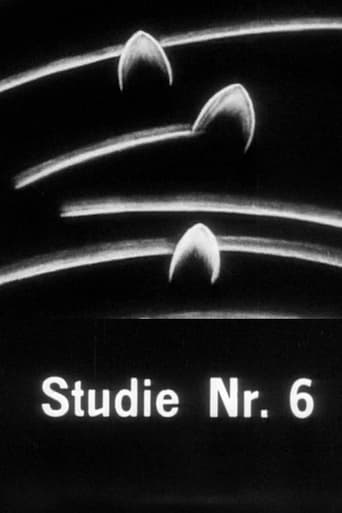
Study No. 6
1930 · ★ 6.6
The first Studies were synchronized with records (Fischinger made a total of 13 Studies all without sound). It was only with the introduction of sound, beginning with Study No 6 that the films did full justice to this musical principle. The play of the white lines, the arcs, and the upside-down U’s running hither and thither like ballet dancers was brought into perfect synchronization with the music, and thus the films offered an abstract illustration of the melodies. Study No 6 is certainly the best of his films in terms of forms. - Hans Scheugl and Ernst Schmidt, Jr. Preserved by the Academy Film Archive in 2001.
More info →
Odds & Ends
1959 · ★ 7.3
Odds & Ends is a sly comment on the collage film and Beat culture. To discarded travel and advertising footage found at a local film laboratory, Belson Shimane added a mélange of animation—assemblages, cutouts, color fields, and line drawings—and faux hipster narration by Jacobs (credited via the anagram Rheny Bojacs) punctuated by a bongo backing. Strung together with doublespeak and non sequiturs, the monologue skirts the edge of nonsense as Jacobs waxes on about poetry, jazz, “reaching the public,” “having a good time,” and—although “money doesn’t count”—the “possibility of subsidy” through grants. Footage of champagne, tropical beaches, and exotic peoples intermingle with rhythmic drawings and stop-motion flights of fancy. The visuals race on through dazzling transformations, both amplifying and undercutting the patter. —National Film Preservation Foundation. Preserved by the Academy Film Archive in partnership with Iota Center Collection in 2006.
More info →