An Evening with Joan Sutherland and Luciano Pavarotti
★ 8 · 1988 · 115m · Music
Opera greats Luciano Pavarotti and Joan Sutherland -- one of the most acclaimed tenors and one of the most beloved sopranos of the 20th century -- take the stage at the Met for a gala evening of opera scenes with special guest Leo Nucci. Filmed in 1987, the memorable program includes scenes from the first and third acts of Donizetti's "Lucia di Lammermoor," the third act of Verdi's "La Traviata" and the third act of Verdi's "Rigoletto."
More Like This
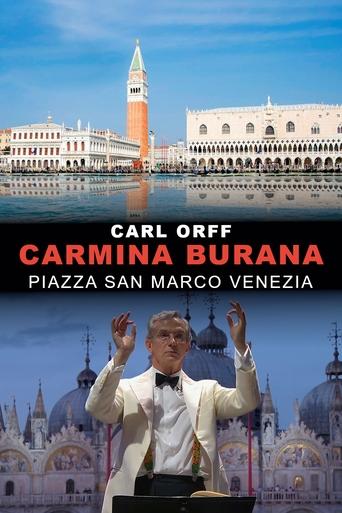
Carmina Burana - Carl Orff in Venedig
2022 · ★ 9
The Choir and Orchestra of the La Fenice Theatre, conducted by Fabio Luisi, take over Piazza San Marco in Venice for a grandiose concert. Facing the basilica, the musicians perform the famous cantata "Carmina burana", twenty-four medieval poems set to music by Carl Orff between 1935 and 1936.
More info →
Waldbühne 2017 | Legends of the Rhine
2017 · ★ 8
For their annual season end concert, the Berliner Philharmoniker take the audience on a dreamy, magically journey through the river Rhine with Schumann’s beloved 3rd Symphony Rhenish. Pieces from Wagner’s Der Ring des Nibelungen under the baton of dynamic conductor Gustavo Dudamel complete this evening.
More info →
Bruckner: Symphony No. 4
2010 · ★ 6
Daniel Barenboim is an expert in exploiting the impact of cyclical performances of composers works: This time he focuses his sharp intellect on all six of Anton Bruckners mature symphonies. Der Tagesspiegel described Barenboim's performance of the works with the Staatskapelle Berlin on six nearly consecutive evenings in June 2010 as a superhuman accomplishment and went on to praise how: His Bruckner is conceived and performed very theatrically, like an opera without words. Bruckners famous Romantic Symphony No. 4 forms the prelude to a spectacular DVD series from Accentus Music and Unitel Classica, exploring Bruckners symphonic cosmos.
More info →
Vespro Della Beata Vergine
1989
This large-scale live recording (Gardiner's second) was made in Venice's St Mark's Basilica. It captures the drama as well as the ceremonial aspect of the work, despite sometimes cloudy recorded sound.” Gramophone Classical Music Guide. “Gardiner's second [recording of the Vespers], spectacularly recorded live in St Mark's, has a punchy choral sound, near-operatic solo singing (Bryn Terfel and Alistair Miles are among the basses), emphatic enunciation, big contrasts and deliberate exploitation of the building's spaces. Its outright theatricality sets it apart from other performances.
More info →
Bruckner: Symphony No. 7
2014
In Anton Bruckner’s 7th Symphony, the listener encounters a music characterized by great spaciousness and profound solemnity, a music which speaks of grief and lamentation, but also of their transcendence. With its monumental architecture and intensity of sound, the symphony has moved listeners ever since its triumphal premiere in 1884. The Guardian calls Daniel Barenboim’s London interpretation “Tremendous … Barenboim and the Staatskapelle seem to have this work in their systems, and the overall impression was of music unfolding organically at its own pace rather than of a work being self-consciously interpreted or led.” Anton Bruckner Symphony No. 7 in E major (original version) Daniel Barenboim, conductor Staatskapelle Berlin Recorded live at the Philharmonie Berlin, 25 June 2010
More info →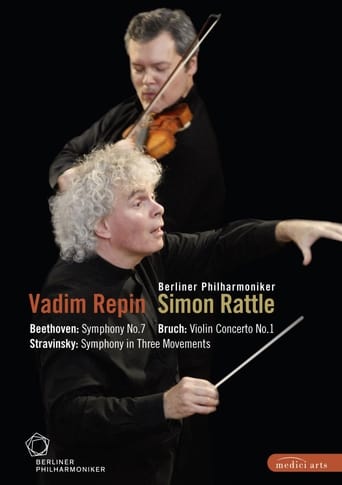
Europakonzert 2008 from Moscow
2008
The Berliner Philharmoniker’s European Concert, held each year on 1 May, is invariably an international highlight. Performing in 2008 in Moscow's renowned Tchaikovsky Conservatory, the orchestra under Sir Simon Rattle presented outstanding performances of works by Beethoven, Stravinsky and Bruch, whose Violin Concerto featured one of today’s most fascinating artists, the Russian violinist Vadim Repin. Stravinsky: Symphony in Three Movements Bruch: Concerto for Violin No.1, op.26 Beethoven: Symphony No.7 in A major, op. 92
More info →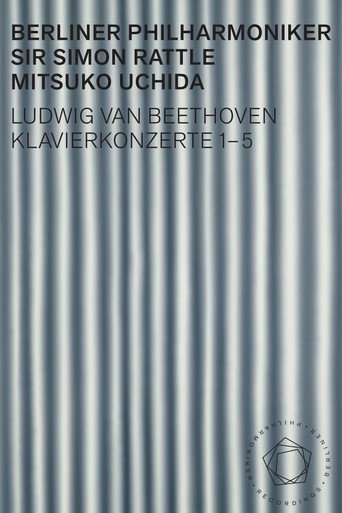
Beethoven: Piano Concertos 1-5 - Uchida, Rattle
2018
There is hardly a better way to approach Ludwig van Beethoven than through his piano concertos. Beethoven’s own instrument was the piano, and in his improvisations – which made him the darling of the Viennese salons – he merged virtuosity and unbridled expression. The piano concertos give a clear idea of these performances. At the same time, they are prime examples of Beethoven’s ability to create large orchestral works with seemingly endless arcs of tension. The complete recording of all five works with Mitsuko Uchida and Sir Simon Rattle was one of the most spectacular projects of the Berliner Philharmoniker during the Rattle era – and at the same time the highlight of the collaboration between the orchestra and the pianist, which began in 1984.
More info →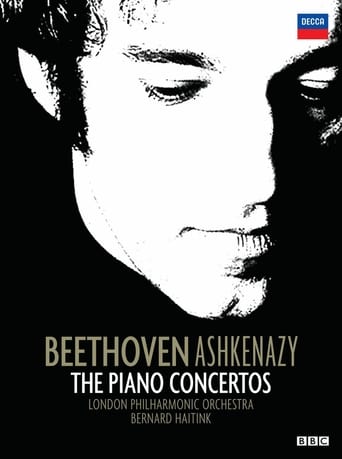
Beethoven Piano Concertos 1-5
1974
These recordings, filmed in March and April 1974 for the BBC, occurred at the tail end of the old performance era and the very start of the new. Vladimir Ashkenazy was a graduate of the same Soviet school of piano playing that produced Sviatoslav Richter, Emil Gilels, Lazar Berman and a host of others of that era. There are simularities that unite them, including a broad romanticism, a degree of Lisztian showmanship coupled with periods of introspection, powerful technique that occasionally borders on pounding and an intellectual streak that produces some deeply insightful playing. Ashkenazy was younger than the others, more modern in his playing.
More info →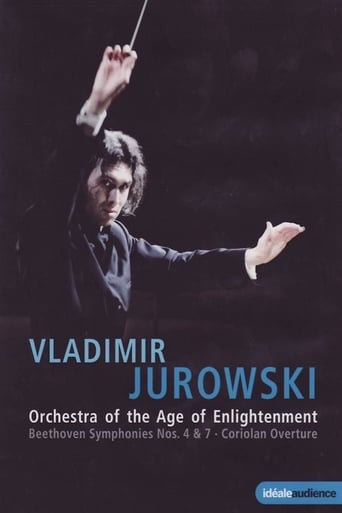
Beethoven Symphonies Nos. 4 & 7; Coriolan Overture
2010
From the very first bars of the Coriolan Overture, it is apparent that this is Beethoven at his very best. Vladimir Jurowski and his absolutely brilliant Orchestra of the Age of Enlightenment give us a new reading of old favorites that may well blow you out of your chair. There is plenty to discover: sounds and textures never heard before, an orchestral timbre as the composer himself may have envisaged and heard, incredible strength and cohesion and, on the other hand, sensitive nuances that often disappear under a blanket of massed strings in more traditional interpretations.
More info →
Bruckner Symphony No. 9
2010
With nearly 450 years of tradition, the Staatskapelle Berlin is one of the oldest orchestras in the world. Daniel Barenboim has served as its music director since 1992, and in 2000 the orchestra appointed him Chief Conductor for Life. Having already performed important cycles such as Beethoven, Brahms and Schumann together, Daniel Barenboim and the Staatskapelle turned their focus toward Anton Bruckner's last six Symphonies, performed in the Philharmonie Berlin in the course of only one week in June 2010. This music is more serious and more significant than one had thought, the Berliner Zeitung summarized in its review of Daniel Barenboims celebrated Bruckner cycle with the Staatskapelle Berlin. Bruckners unfinished Symphony No. 9 brought to an end, in a poignant manner, the work of one of the greatest symphonic composers of the Classic-Romantic era.
More info →
Vivaldi Le Quattro Stagioni
2008
In April 1981 violinist Gidon Kremer performed Vivaldi's Four Seasons leading the English Chamber Orchestra recorded in the baroque library of the monastery in Polling, near Munich. It is, as one would expect from a master violinist, a superbly insightful performance. The sound is resonant and satisfying although surely not true 5.1, and those who wish to have this music on video might well investigate it.
More info →
Bruckner: Symphony No. 6
2014
Anton Bruckner’s 6th Symphony was written between 1879 and 1881: a very happy time in his life. Unlike most of Bruckner’s symphonies, the 6th was not revised. Of all his works, this one seems to come from a single source of inspiration. Bruckner himself called it his “boldest” symphony – probably due to its extreme degree of motivic, rhythmic and harmonic originality. This live recording of the seldom-performed 6th Symphony is the next instalment of the acclaimed Bruckner cycle by the Staatskapelle Berlin and Daniel Barenboim. Anton Bruckner Symphony No. 6 in A major (original version) Daniel Barenboim, Conductor Staatskapelle Berlin Recorded live at the Philharmonie Berlin, 22 June 2010
More info →